Drainage Contractor London
KiKK Groundworks is a drainage groundworks contractor working across London. CCTV drainage surveys, excavation and repair of failed Victorian clay runs, new connections, soakaways and SuDS. We survey first, price against what the camera shows, and fix the cause rather than the symptom.


100+ Happy Customers
A very large share of London's housing stock still drains through the pipework it was built with. Salt-glazed clay, laid in short lengths, jointed in mortar, bedded on whatever was to hand at the time. It was good engineering for its day and a lot of it is still running. But clay is brittle, mortar joints are not, and a hundred and twenty years of ground movement, traffic vibration and seasonal clay shrinkage does the rest.
The failure sequence is always the same. A joint opens a millimetre or two. Fine root hairs from a nearby tree find the moisture and go through the gap. Inside the pipe, where there is water and air, those hairs turn into a root mass. The mass catches everything passing down the run, silt builds behind it, and the drain that used to block once a decade starts blocking twice a year.
London's mature street trees are the driver. The same plane trees, limes and poplars cause clay subsidence claims across the inner boroughs. They are not going anywhere, and in most cases they should not. The answer is a drain that roots cannot get into: a sealed run, in modern pipe, on a proper bed and surround.
Sitting behind all of that is the other Victorian legacy: combined sewers, taking foul and surface water in the same pipe. They were sized for a London with far less hard surfacing than it has today. Every front garden that gets paved and every roof extension that ties into the same old run adds flow to a network already at capacity in heavy rain. That is why surface water is now expected to be managed on the plot, and why a competent London drainage job thinks about where the rainwater goes, not only where the foul goes.
KiKK works the way the rest of the site does: the surface is never the problem, the ground underneath it is. See the whole picture first, then dig once.
No drain is excavated on a guess. A CCTV survey establishes what has failed, where it has failed and how deep it sits before a price is written. Guesswork is how London drainage bills double.
KiKK is a groundworks contractor. We excavate, replace and reinstate failed runs, which is the permanent fix, rather than jetting the same blockage clear every six months.
Street works accreditation for excavation affecting the public highway, and full public liability cover on every London site. Both confirmed in writing before work begins.
Soakaways, attenuation and permeable surfacing specified against a percolation test, not assumed. London Clay does not accept water the way a brochure says it should.
You get a costed repair plan tied to the survey footage, item by item. If ground conditions change what is needed, you are told before anything is done, not after.
Kallan runs the job personally. No layers of project managers, no subcontracted crew you have never met turning up at a London terrace with a breaker.
A CCTV drainage survey is a camera on a flexible rod or crawler, run through the drain from the chambers, recording the condition of the pipe metre by metre. It is the cheapest thing you can buy in London drainage and it decides everything that follows.
Without one, a contractor digging a London drain is guessing at the depth, the line, the material, the fall and the defect. Guesswork on a terraced plot with hand-dig access is expensive. The survey turns a vague problem (“it keeps backing up”) into a specific one: a fractured clay socket 8.4 metres from the rear chamber, with root ingress, and 30mm of standing water behind it.
The camera shows pipe material and diameter, joint displacement, fractures and cracks, root mass and where it entered, standing water indicating a back-fall or a partial collapse, silt and scale build-up, and connections that appear on no drawing anywhere, which in London is most of them. Depths and distances are recorded, so a defect can be located on the ground before a spade goes in.
You receive the footage and a written report with a plan of the runs. You also get the part that actually matters: a costed repair plan. Not a scare story and not an open-ended day rate. A list of defects, each with a recommendation, each with a price, in priority order. Some of it may not need doing this year. You are told which.
Guide cost: £180 to £450 for a standard London domestic survey, more for commercial or multi-run sites. If the survey leads to remedial work carried out by KiKK, the survey cost is credited against the repair.
KiKK is a groundworks drainage contractor, not a 24-hour unblocking service. We do not sell an emergency call-out with a response time we cannot honestly promise. What we do is the excavation-led work: survey, dig, repair, replace, install, reinstate.
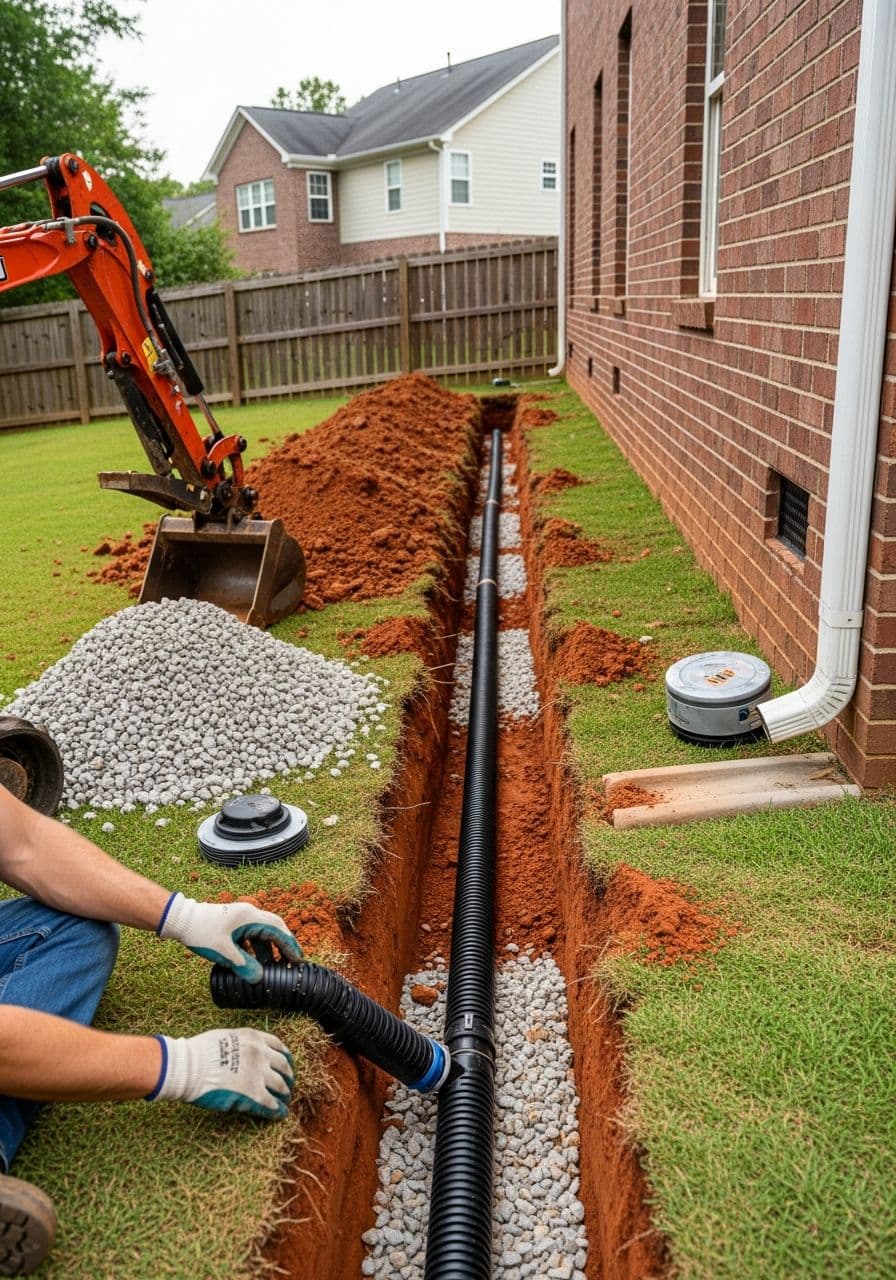
Where the camera finds a fractured, displaced or root-invaded section, the permanent fix is to excavate it, cut out the failed length and replace it in modern pipe on a proper granular bed and surround. On a terraced plot with no rear access this often means hand-digging, working through the house, or craning plant over. All of that is priced honestly up front rather than discovered halfway through.
Drain excavation in central London brings its own constraints: shallow services, party wall proximity, restricted working hours and no room to stack spoil. It is slower work and it is priced as such. What it is not is guesswork.
New foul and surface water runs for extensions, loft conversions with new bathrooms, garden rooms and outbuildings. Connections into the existing system or into a public sewer where consented. Inspection chambers and rodding points positioned so that the run can actually be maintained, to Building Regulations Part H. If your project also needs the substructure, see our foundations and underpinning in London service. Drainage and foundations are designed together, not sequentially.
The London Plan expects surface water to be managed on site, as high up the drainage hierarchy as the ground allows: rainwater reuse, then infiltration, then attenuated discharge, and only then the sewer. That is not bureaucracy for its own sake. London's combined sewers are at capacity and surface water flooding is a growing, measurable London problem.
In practice that means a percolation test to BRE 365 before anything is specified. Most of London sits on London Clay, which infiltrates slowly, and a soakaway sized off a standard table will simply fill and stay full. Where the ground fails, KiKK specifies attenuation crates with a controlled discharge, permeable surfacing, or a combination. On the Thames gravel terraces in parts of west and east London the ground drains far better and a conventional soakaway is straightforward.
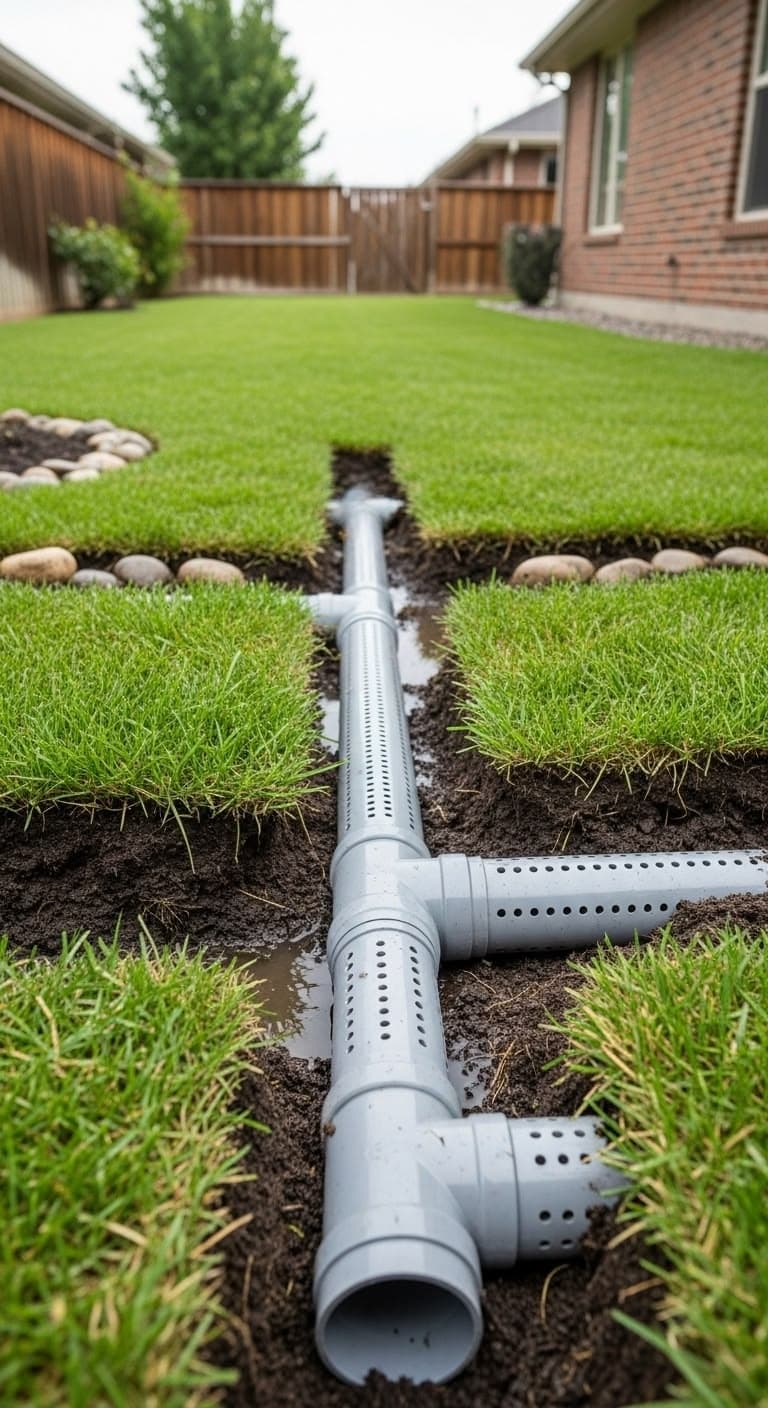
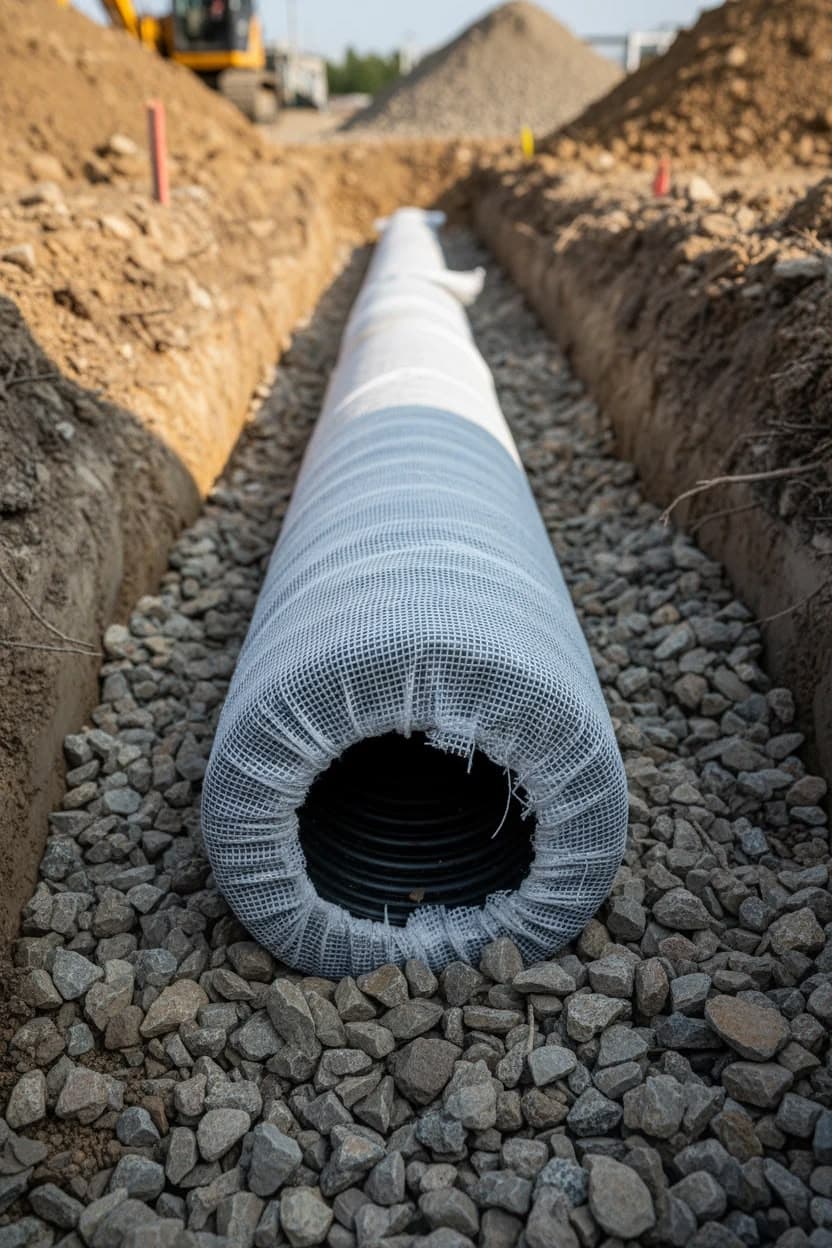
London Clay gardens that sit under water from November to March are not a lawn problem, they are a drainage problem. Perforated land drain in a gravel-filled trench, laid to a fall, discharging to a soakaway or an attenuated outfall. Combined with site clearance in London where the ground needs stripping back before the levels can be reset.
Yard and car park drainage, channel and linear drainage, interceptors, gully and chamber replacement, and drainage for commercial fit-outs and change-of-use projects. Programmed around restricted working hours and out-of-hours access where the site demands it, and coordinated with the wider civil engineering works where drainage is one package within a bigger job.
Below sewer invert level, gravity drainage does not exist. A lower-ground WC, utility or kitchen in a London basement drains by pump: a sealed sump chamber, a duty pump, a non-return valve and a rising main up to the gravity system. Where the basement is also being tanked or dug out, the drainage and the waterproofing have to be designed as one system. A sump that has to fight a failed tanking detail is a maintenance problem for the rest of the building's life.
This is the question that decides who pays, and almost nobody explains it properly. Since the private sewer transfer in October 2011, most shared lateral drains and private sewers in England and Wales passed to the water company. In London that is Thames Water for the great majority of the capital.
What you own: the drain within your property boundary that serves only your property. The gully outside your kitchen, the run from your soil stack across your own garden, your inspection chamber. If it fails, it is your bill.
What Thames Water owns: the public sewer, and the shared lateral drains and sewers that transferred in 2011. That includes any drain that takes flow from more than one property: the classic London terrace scenario, where four or five houses feed into one run along the back of the gardens. It also includes the section of your own drain once it passes beyond your boundary, out under the pavement or the road, on its way to the sewer.
The practical consequence: a homeowner in a Victorian terrace, whose drain blocks repeatedly, may be paying to clear a defect on a pipe they do not own and are not responsible for repairing. The way you establish that is a CCTV survey. The footage shows the defect, the distances place it relative to the boundary, and the report is what you send to Thames Water.
KiKK will tell you honestly if the fault is on the water company's asset. That is a survey fee earned and a repair job we do not get. It is still the right answer.
If you are building within 3 metres of a public sewer or a shared lateral drain, you need a build over or build near agreement from Thames Water before work starts. In London this catches an enormous number of rear extensions, because the shared run along the back of a terrace sits exactly where the new kitchen is going.
What the agreement asks for depends on the pipe: it may be enough to bridge the sewer with the foundation and keep the load off it, or to build a new access chamber, or the sewer may need diverting entirely. All of that changes the foundation design and the cost. It has to be known before the foundation is priced, not after it is dug.
Building Control will ask to see the agreement. The most common way a London extension stalls is a homeowner who discovers the sewer once the trench is open. A survey and a sewer records check at design stage costs a fraction of that delay.
London drainage prices sit above the national average for a reason: hand-dig on restricted plots, muck-away in a ULEZ zone, permits, and depth. The figures below are honest guide ranges pending a survey. A fixed written price follows the CCTV footage, not the phone call.
| Work | Guide Cost | Notes |
|---|---|---|
| CCTV drainage survey (domestic) | £180 - £450 | Written report and footage supplied |
| CCTV survey (commercial / multi-run) | £400 - £900 | Depends on run count and access |
| Excavate and repair a failed section | £900 - £2,800 | Per localised defect, typical depth |
| Replace a full drain run | £2,500 - £6,500 | Rear of terrace, hand-dig allowance |
| New soakaway (crate system) | £1,200 - £3,500 | Subject to percolation test result |
| New inspection chamber | £450 - £1,200 | Depth and material dependent |
Guide prices only, pending a survey. Depth, access, ground conditions, permits and the state of what is already in the ground all move the number. Every KiKK quote is written and fixed.
Find out what is actually wrong before anyone quotes you for digging. Footage, written report and a costed repair plan.
Half of what makes a London drainage job different has nothing to do with the pipe. Most terraces have no side access, so plant cannot reach the rear. The excavation is hand-dug and the spoil is barrowed through the house on boards, or lifted over. That is a labour cost and it belongs in the quote, visibly, not as a variation later.
Then there is the paperwork around it: skip and hoarding permits from the borough, controlled parking zone suspensions for the grab lorry, restricted delivery hours on some streets, and ULEZ compliance for every vehicle and muck-away movement. Where excavation affects the public highway, that is street works and it needs the accreditation to match.
None of it is difficult. All of it has to be planned. A contractor who has not costed the permits and the hand-dig is not cheaper. They are just going to ask you for the money later.


KiKK is a drainage groundworks contractor. That is a deliberate distinction. We are not selling a 24/7 emergency unblocking van with a promised response time. Plenty of London drainage companies do that, and some of them do it well. What we do is the part that comes after the jetting stops working: find the defect, price the repair, dig it out, put it right.
And if the survey shows the problem is on a Thames Water asset, we say so.
Drainage services across Greater London: central, north, south, east and west. For the full range of groundworks in the capital, see all KiKK London services.
FAQ
A CCTV drainage survey in London typically costs £180 to £450 for a standard domestic property, with a written report and the footage supplied. Larger properties, commercial sites, multiple runs or difficult access push the figure towards £600. A pre-purchase survey on a Victorian terrace usually sits at the lower end. These are guide prices. The exact cost depends on the number of runs, chamber access and whether the survey needs to be carried out from the highway.
You are responsible for the drain inside your property boundary that only serves your property. Thames Water is responsible for the public sewer and, since the October 2011 private sewer transfer, for shared lateral drains and shared sewers, including the section of your drain that runs beyond your boundary. In practice: if the pipe only serves your house and is within your boundary, it is yours. If it takes flow from a neighbour, or it has left your boundary, it is almost certainly Thames Water's. A CCTV survey establishes which side of that line the defect sits on, which decides who pays.
If you are building within 3 metres of a public sewer or a shared lateral drain, you need a build over or build near agreement from Thames Water before the work starts. This is extremely common on London extensions because rear-of-plot sewers run behind long lines of terraces. The agreement may require the sewer to be diverted, a new chamber to be built, or the foundation to be designed to bridge the pipe. Building Control will ask for it. Applying late is the single most common cause of a stalled London extension.
Because most of them are original Victorian salt-glazed clay pipe laid in short sections with mortar joints. Over 120 years the joints open, the pipe cracks, sections drop out of line and the bed of the pipe silts up. Roots from London's mature street trees find the open joints and grow in. Once there is a root mass or a displaced joint, everything that passes down the run snags on it. Repeated jetting clears the symptom for a few months. Only excavating and replacing the defective section clears the cause.
The pattern is recognisable: a drain that blocks every few months rather than once, slow-clearing WCs, gurgling, and a mature tree within about 10 to 15 metres of the run. Jetting clears it and then it comes back. The only way to confirm it is a CCTV survey. The camera shows the root mass, where it entered, and whether the pipe around it is cracked or displaced. That footage is also what an insurer will want to see before considering a claim.
A soakaway is an underground void (traditionally rubble, now normally plastic crates) that takes surface water from roofs and hard surfaces and lets it soak into the ground rather than discharging to the sewer. On London Clay, infiltration is slow and a conventional soakaway often will not perform, which is why a percolation test to BRE 365 is carried out before anything is specified. Where the ground fails the test, attenuation crates with a controlled discharge rate, permeable surfacing or a rain garden are the correct alternatives. On the Thames gravel terraces in parts of west and east London, infiltration is usually far better and a soakaway is straightforward.
Other Services
Tell us what the drain is doing and we will tell you what it takes to find out why. CCTV survey, written report, costed repair plan, fixed-price quote.